
صحافة الكترونية مرخصة وزارة الاعلام ترخيص رقم 366-2019

صحافة الكترونية مرخصة وزارة الاعلام ترخيص رقم 366-2019
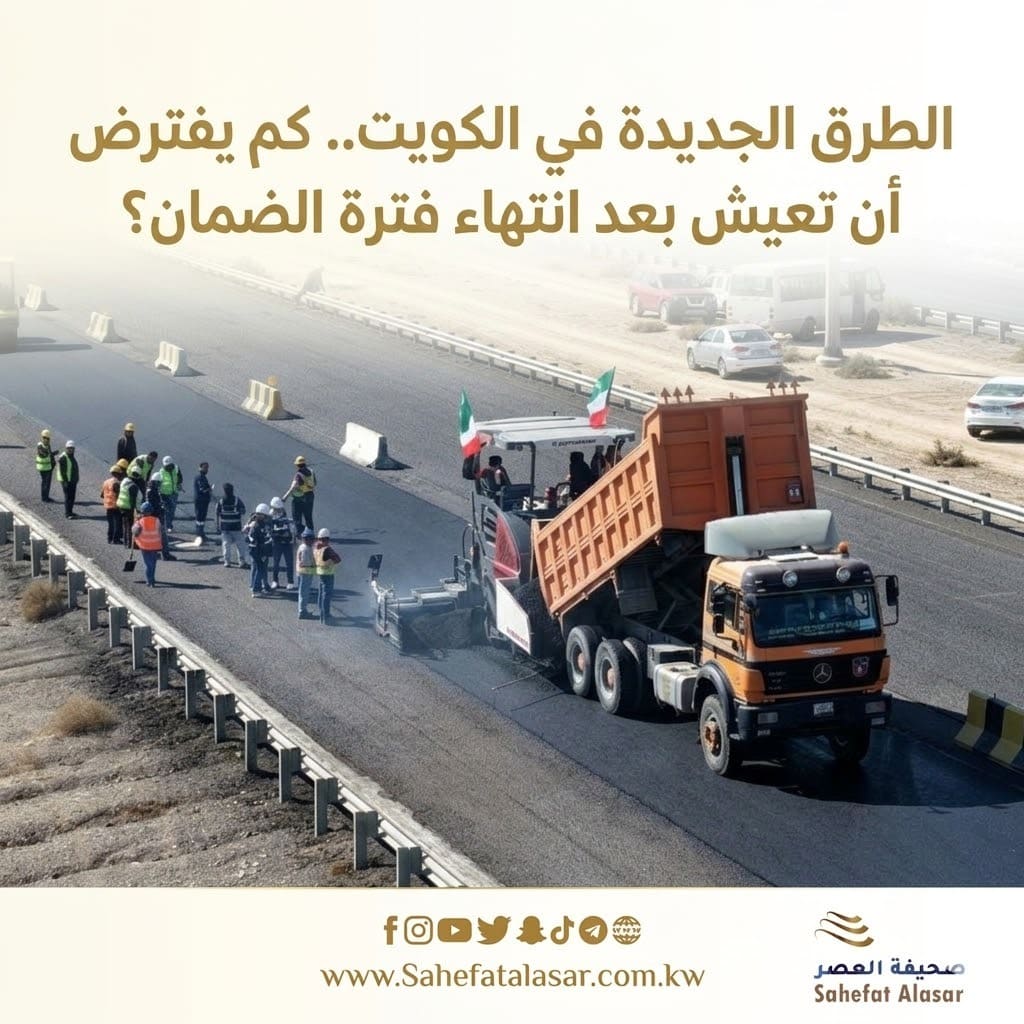
After years of complaints related to flying gravel, cracks, potholes, and subsidence on a number of main and internal roads, the government placed the roads file at the top of its priorities, and through the Ministry of Public Works launched the largest program for the radical maintenance and rehabilitation of the road network in Kuwait in years.Official figures show that the current program is valued at approximately 400 million dinars, encompassing 18 contracts covering highways and internal roads in various regions of the country, with an implementation period of up to three years, followed by a five-year warranty period and a ten-year guarantee.As several projects near completion, a question arises for many citizens: How long are the new roads expected to last after the warranty period ends? Will the previous problems reappear after a few years, or is the road network entering a different phase in terms of quality and operational lifespan?Roads constructed under current major maintenance contracts are subject to a five-year warranty period before final handover to the Ministry of Public Works, which then assumes responsibility for follow-up and periodic maintenance through dedicated contracts. However, experts emphasize that the warranty period does not represent the road's lifespan. A road constructed according to approved technical specifications and engineering standards can remain in service for a much longer period if it undergoes regular preventative maintenance. [Aerial view of the Cairo Street rehabilitation project: Major maintenance... What's the difference?In recent years, road maintenance has been associated by many citizens with patching potholes or resurfacing limited sections of the road, procedures often considered routine maintenance. However, the comprehensive maintenance currently being carried out by the Ministry of Public Works is significantly different. It includes removing damaged pavement layers, rehabilitating the base layers, and addressing the structural and technical problems that led to road deterioration, before applying new asphalt layers according to updated specifications that are suitable for Kuwait's climate and environment.According to announcements made by the relevant authorities upon signing the contracts, this project is the first of its kind in terms of its comprehensiveness, covering complete maintenance of highways and internal roads in various governorates, making it the largest direct road network rehabilitation program in recent years. What is the average lifespan of roads?The head of the Kuwait Society of Engineers, Eng. Mohammed Al-Subaie, believes that the Ministry of Public Works has set technical specifications for asphalt mixes and established maintenance plans that are compatible with local climatic conditions, stressing the existence of significant governmental efforts to address the accumulated problems that this sector has witnessed over the past years.Regarding the lifespan of roads, a former official at the Ministry of Public Works stated that a road can serve for approximately 15 years if preventative maintenance programs are implemented regularly, while its lifespan may not exceed five years in the absence of such programs or if early intervention is not undertaken to address technical defects, cracks, and potholes when they appear.He explained that preventive maintenance relies on early intervention as soon as signs of damage appear, while major maintenance comes after the road reaches an advanced stage of deterioration. This means that the success of current road projects will depend not only on the quality of execution but also on the continuation of follow-up and periodic maintenance after the warranty period expires. Heavy trucks on the Fifth Ring Road: Heavy loads and heat are among the most prominent challenges.Officials and experts confirm that overloading represents one of the biggest challenges facing roads in Kuwait. In this context, a former official at the Ministry of Public Works explained that the lack of appropriate and specified weight limits for some roads accelerates the deterioration of pavement layers, especially on roads with heavy truck and vehicle traffic. He added that high temperatures also play a significant role in the wear and tear of asphalt layers over time, making the quality of materials used and the precision of construction essential factors in withstanding harsh climatic conditions.